Biscuit making machines are industrial food-processing systems designed to turn prepared ingredients into shaped, baked, cooled, and sometimes packaged biscuits.
They are used in bakeries, food-processing plants, and larger commercial production facilities where consistent processing is required.
Traditional biscuit production involves several manual steps, including mixing ingredients, preparing dough, shaping pieces, baking, cooling, and packing. Machinery connects many of these stages into an organized production process.
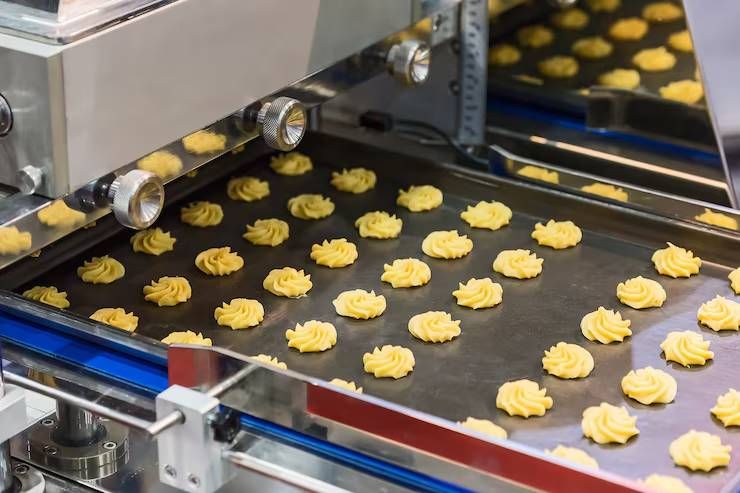
A typical biscuit production line may include:
- Ingredient preparation and weighing equipment
- Dough mixers
- Dough feeding and laminating systems
- Rotary moulders or cutting machines
- Baking ovens
- Cooling conveyors
- Biscuit stacking systems
- Inspection equipment
- Packaging machinery
Different biscuit varieties require different processing conditions. Hard-sweet biscuits, crackers, cookies, cream biscuits, and other products can differ in dough composition, thickness, shape, baking temperature, and moisture requirements.
The main purpose of biscuit manufacturing machinery is therefore not simply automation. It is to provide controlled and repeatable processing conditions across large production volumes.
How a Biscuit Production Line Works
A biscuit production line generally follows a sequence of connected stages. The exact configuration depends on the product and production scale.
| Production Stage | Main Equipment | Primary Function |
|---|---|---|
| Ingredient preparation | Weighing and feeding systems | Measures and supplies ingredients |
| Mixing | Dough mixer | Combines ingredients into dough |
| Dough preparation | Laminator or sheeter | Produces the required dough thickness |
| Forming | Rotary moulder or cutter | Creates biscuit shapes |
| Baking | Industrial oven | Develops texture, color, and structure |
| Cooling | Cooling conveyor | Reduces product temperature |
| Inspection | Metal detector or vision system | Supports quality and safety checks |
| Packaging | Packaging equipment | Protects the finished product |
The process begins with controlled ingredient preparation. Flour, sugar, fats, leavening agents, water, and other ingredients are normally measured according to the product formulation.
The dough is then mixed to achieve the desired consistency. Depending on the biscuit type, the dough may be sheeted, laminated, extruded, or moulded.
Forming equipment determines the biscuit's shape and dimensions. Baking follows, with temperature, humidity, conveyor speed, and oven-zone conditions influencing the final characteristics.
After baking, biscuits are cooled before further handling. Cooling is important because packaging products while they are still too warm can contribute to condensation and affect product quality.
Types of Biscuit Making Machines
Biscuit machinery is available in different configurations because biscuit products vary considerably.
Dough mixers combine ingredients and help produce a consistent dough. Mixing speed, time, bowl design, and batch capacity can affect processing results.
Rotary moulding machines are commonly associated with moulded biscuits. Dough is pressed into engraved moulds and released onto the production line.
Wire-cut machines are used for certain cookie and biscuit doughs. They portion dough into individual pieces before baking.
Sheeters and laminators are used when a biscuit requires controlled dough thickness or layered dough construction. They can be important for crackers and laminated products.
Tunnel ovens provide continuous baking. Different oven zones can be controlled to manage heating and moisture removal throughout the baking process.
Cooling conveyors transport baked biscuits while allowing heat to dissipate before subsequent handling.
Packaging machines can perform operations such as feeding, wrapping, sealing, and date or batch coding, depending on the production configuration.
Why Biscuit Machinery Matters Today
Biscuit production has to balance consistency, food safety, production efficiency, energy use, and product quality. Machinery helps manufacturers manage these requirements in a controlled production environment.
One important benefit is process consistency. Manual production can introduce differences in dough thickness, shape, baking time, and portion size. Automated equipment can reduce variation when it is properly configured and maintained.
Machinery can also help reduce direct handling of food products. This can support hygiene controls when equipment is designed, cleaned, and operated according to appropriate food-safety procedures.
Modern systems increasingly incorporate sensors and digital controls. These can monitor temperatures, conveyor speeds, operating conditions, and selected production parameters.
Another important issue is energy management. Baking is one of the most energy-intensive stages of biscuit production, so oven efficiency and heat management are important considerations for larger facilities.
Recent Developments in Biscuit Manufacturing
Recent developments in food-processing machinery have focused on automation, monitoring, hygiene, energy efficiency, and data collection.
In India, food-processing policy and infrastructure development have continued to receive government attention. The Ministry of Food Processing Industries has continued programs related to food-processing capacity, food safety, preservation infrastructure, and agro-processing clusters.
In July 2026, MoFPI published the status of approved projects under the Creation/Expansion of Food Processing and Preservation Capacities scheme as of July 1, 2026.
Food-safety regulation has also continued to develop. FSSAI's notification records show several regulatory updates during 2026, including amendments concerning contaminants, packaging, labelling, laboratory procedures, and food-business regulation.
On September 18, 2026, FSSAI notified an amendment concerning laboratory and sample-analysis procedures, including timelines, analytical methods, and testing report formats.
These developments matter to biscuit-processing facilities because machinery, production controls, testing procedures, packaging, and hygiene systems operate within the wider food-safety framework.
Important Technical Trends
Several technical trends are shaping industrial biscuit production:
- Programmable controls: Digital control systems can manage selected machine settings and production parameters.
- Automated material handling: Conveyors and feeding systems reduce unnecessary manual movement.
- Machine vision: Cameras can help identify selected defects, shape variations, or foreign-material concerns.
- Data monitoring: Sensors can collect information about temperature, speed, pressure, and other operating conditions.
- Energy management: Oven insulation, heat recovery, and controlled heating can support more efficient operation.
- Hygienic design: Equipment is increasingly designed with cleanable surfaces and accessible areas for inspection and sanitation.
Laws, Food Safety, and Policies in India
Biscuit production in India is affected by the Food Safety and Standards Authority of India (FSSAI) and the broader Food Safety and Standards framework. Food businesses need to follow applicable requirements relating to food safety, hygiene, ingredients, processing, packaging, labelling, and licensing.
Machinery itself also needs to be considered from a safety and hygiene perspective. The Bureau of Indian Standards maintains standards relating to food-processing equipment. For example, BIS lists standards covering food-processing machinery and safety or hygiene requirements for particular equipment categories.
BIS explains that where a relevant product standard applies, conformity assessment can involve manufacturing infrastructure, process controls, quality control, testing capabilities, and assessment procedures.
Government food-processing programs can also influence the development of processing infrastructure. PMKSY has included components covering food-processing and preservation capacity, food safety and quality assurance infrastructure, and agro-processing clusters.
As regulations can change, businesses should consult current FSSAI, BIS, and MoFPI publications rather than relying only on older machinery specifications or regulatory summaries.
Useful Tools and Resources
Several resources can help readers understand biscuit production and food-processing requirements:
- FSSAI: Food-safety regulations, notifications, licensing information, and compliance resources.
- Bureau of Indian Standards: Indian Standards and information concerning conformity assessment and relevant equipment standards.
- Ministry of Food Processing Industries: Information about food-processing policies, schemes, infrastructure programs, and official updates.
- Production monitoring systems: Used to track operating parameters such as oven temperature, conveyor speed, and production quantities.
- Energy monitoring tools: Useful for reviewing electricity or fuel consumption associated with ovens and other machinery.
- Quality-control checklists: Can organize routine checks covering biscuit dimensions, moisture, color, texture, packaging integrity, and equipment hygiene.
Frequently Asked Questions
What is a biscuit making machine?
A biscuit making machine is equipment used to automate one or more stages of biscuit production. Depending on its configuration, it may mix dough, form biscuits, bake them, cool them, inspect them, or prepare them for packaging.
What machines are used in a biscuit production line?
A typical line may contain dough mixers, sheeters or laminators, rotary moulders or cutters, tunnel ovens, cooling conveyors, inspection equipment, and packaging machinery. The exact combination depends on the biscuit formulation and production process.
What is the role of a tunnel oven in biscuit manufacturing?
A tunnel oven provides continuous baking as biscuits move through controlled heating zones. Temperature, conveyor speed, and heat distribution can influence moisture removal, texture, color, and overall baking consistency.
Why is cooling important after baking?
Cooling allows biscuits to reach a suitable temperature before subsequent handling or packaging. Insufficient cooling can contribute to condensation and may affect product quality.
Are biscuit machines affected by Indian food-safety regulations?
Yes. Biscuit production facilities must comply with applicable Indian food-safety requirements. Equipment selection and operation also need to support appropriate hygiene, sanitation, process control, and food-safety practices.
Conclusion
Biscuit making machines form an important part of modern food-processing operations. They connect stages such as mixing, dough preparation, forming, baking, cooling, inspection, and packaging into a controlled production workflow.
The appropriate machinery depends on the biscuit formulation, production method, required capacity, available space, energy requirements, hygiene considerations, and quality-control procedures.
In India, biscuit-processing operations also function within an evolving regulatory environment involving FSSAI, BIS, and government food-processing programs. Recent updates in 2026 demonstrate the continuing development of food-safety procedures, testing requirements, and processing infrastructure.