An engine test bench is a controlled testing system used to evaluate an engine without relying entirely on road or field conditions.
It holds the engine in a test cell and connects it to measurement, control, cooling, fuel, exhaust, and data-acquisition systems. A dynamometer applies or absorbs mechanical load while sensors record parameters such as torque, speed, power, temperature, pressure, fuel consumption, and emissions.
Engine test benches exist because engine development requires repeatable measurements. Road testing can be affected by traffic, weather, driver behavior, road gradients, and other variables. A controlled test bench allows engineers and researchers to repeat defined operating conditions and compare results.
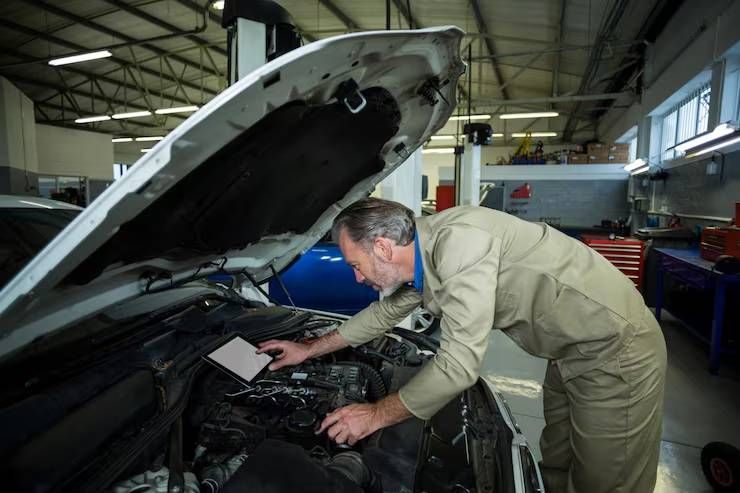
Depending on its design, an engine test bench can support gasoline, diesel, CNG, hydrogen, ethanol, methanol, biodiesel, and other powertrain technologies. Modern facilities may also include transient dynamometers, emission analyzers, high-speed data acquisition, ECU interfaces, and environmental conditioning systems. ARAI, for example, lists steady-state and transient engine test cells covering a broad range of power levels.
How an Engine Test Bench Works
The engine is securely mounted to a test stand and mechanically connected to a dynamometer. The dynamometer can control engine speed or load according to the test procedure.
Key systems generally include:
- Engine dynamometer: Measures torque and controls mechanical load.
- Fuel measurement system: Records fuel flow and consumption.
- Air and coolant conditioning: Maintains controlled operating conditions.
- Emission measurement equipment: Measures pollutants and other exhaust components.
- Sensors: Monitor pressure, temperature, speed, vibration and combustion-related parameters.
- Data acquisition system: Collects and synchronizes measurements.
- Control software: Automates test cycles and manages operating conditions.
- Safety systems: Monitor temperatures, pressure, fuel, exhaust, rotating machinery and emergency conditions.
A typical testing sequence involves installing the engine, checking instrumentation, establishing operating conditions, running a prescribed test cycle, collecting measurements, and analyzing the resulting data.
| Test area | Typical measurements | Main purpose |
|---|---|---|
| Performance | Torque, speed, power | Evaluate engine output |
| Fuel efficiency | Fuel flow, air flow | Assess energy use |
| Emissions | CO, HC, NOx, PM, PN | Evaluate exhaust emissions |
| Durability | Temperature, pressure, wear indicators | Assess long-duration operation |
| Calibration | ECU parameters, combustion data | Refine engine control |
| Thermal management | Coolant and oil temperatures | Evaluate heat control |
Why Engine Test Benches Matter Today
Engine testing has become more important as manufacturers and research organizations work with stricter emissions requirements, alternative fuels, hybrid systems, and increasingly complex electronic controls.
For conventional internal-combustion engines, controlled testing helps determine whether an engine meets required performance and emissions targets. For example, engine dynamometer testing can be used for steady-state and transient emission cycles, power measurements, smoke testing, and fuel-consumption evaluation.
The technology also supports:
- Engine performance testing during development and validation.
- Engine calibration testing for fuel injection and electronic control systems.
- Engine durability testing under repeated operating conditions.
- Emission compliance testing against applicable standards.
- Alternative-fuel engine testing for fuels such as CNG, hydrogen and ethanol.
- Powertrain development for hybrid and electric systems.
- Research and academic testing involving combustion, thermal management and energy efficiency.
Engine test benches affect vehicle manufacturers, component developers, research institutions, certification laboratories, universities and organizations developing industrial engines, tractors, construction equipment and generator sets.
A major advantage is repeatability. If an engine is tested at a particular speed and load, the same operating point can generally be reproduced later. This makes it easier to compare changes in combustion calibration, engine hardware, lubricants, cooling strategies, after-treatment systems or fuels.
Recent Developments in Engine Testing
Engine test benches are increasingly being designed around multiple powertrain technologies rather than only conventional internal-combustion engines.
One important trend is the integration of test systems with hybrid and electric powertrain evaluation. A 2026 SAE technical paper described a scalable, modular chassis-dynamometer framework designed to evaluate hybrid and electric powertrain architectures using physical and virtual testing elements.
Another development is the growing attention to alternative fuels. ARAI's current engine-testing infrastructure includes facilities for diesel, gasoline, CNG, biodiesel, ethanol, ED95 and methanol, while its national-interest projects include a dedicated hydrogen engine test cell.
In India, ARAI reported the development of an 800 kW heavy-duty engine test facility to support development and certification of higher-power engines.
Testing is also becoming more data-intensive. Modern engine test cells can combine high-speed acquisition with combustion-pressure measurements, ECU data, particulate measurements, FTIR analysis, fuel-flow measurements and environmental conditioning.
A particularly significant policy development occurred in September 2026, when India notified new Corporate Average Fuel Economy (CAFE) norms for passenger vehicles. The rules will apply from 1 April 2027 through 31 March 2032, progressively tightening the applicable fuel-consumption benchmarks.
These developments increase the importance of accurate powertrain measurement, repeatable fuel-consumption testing and data management.
Laws, Standards and Policies in India
Engine test benches used for automotive development and certification operate within a regulatory environment that includes the Central Motor Vehicles Rules (CMVR), Bharat Stage emission requirements, AIS standards and applicable testing procedures.
The Automotive Research Association of India states that automotive engines above certain vehicle weight categories are normally tested on an engine dynamometer for separate engine emissions and power approval.
AIS 137 is particularly important for automotive emissions testing. Its provisions cover areas including engine emission measurement and durability-related procedures.
For vehicles operating under Bharat Stage VI requirements, in-service conformity and OBD-related requirements also form part of the regulatory framework. ARAI describes ISC and IUPR as mandatory requirements under applicable BS-VI/OBD-II emission regulations.
Generator engines and other non-automotive applications can fall under separate requirements. Current ARAI test facilities, for example, include testing of genset engines under CPCB requirements and other applicable standards.
Another major development is India's new CAFE framework. The Ministry of Power notified the new CAFE norms on 29 September 2026. They apply to M1 passenger vehicles from 2027–28 through 2031–32 and establish progressively tighter annual average fuel-consumption standards.
For engine and powertrain development, such regulations mean that test data must be generated using appropriate procedures, calibrated instruments and traceable measurement practices.
Tools and Resources for Engine Testing
Several resources can help readers understand or plan engine testing activities:
- ARAI Engine Development Laboratory: Provides information about engine dynamometer, durability and powertrain testing capabilities in India.
- ARAI Certification Resources: Useful for understanding engine type approval, conformity of production and related automotive certification requirements.
- MoRTH AIS Documents: Government technical documents provide detailed procedures and requirements for automotive emissions and related testing.
- Bureau of Energy Efficiency: Provides information on energy-efficiency policies and CAFE requirements.
- SAE technical literature: Useful for research on engine test benches, dynamometers, hybrid powertrains and emerging testing approaches.
- NABL accreditation information: Relevant when assessing laboratory competence and testing quality under ISO/IEC 17025.
Frequently Asked Questions
What is an engine test bench?
An engine test bench is a controlled setup used to measure engine performance, fuel consumption, emissions, durability and other operating characteristics. It normally combines an engine dynamometer with sensors, control equipment and data-acquisition systems.
What is an engine dynamometer used for?
An engine dynamometer measures torque and rotational speed while controlling the mechanical load applied to an engine. These measurements can be used to determine power and evaluate engine behavior under different operating conditions.
What parameters are measured during engine testing?
Common parameters include torque, speed, power, fuel flow, air flow, coolant temperature, oil temperature, exhaust temperature, pressure and emissions. Advanced facilities may also measure particulate number, combustion pressure and additional exhaust compounds.
Are engine test benches used for emissions testing?
Yes. Engine dynamometer test cells can be equipped with emission analyzers and particulate measurement systems. ARAI describes facilities capable of measuring gaseous emissions, particulate matter, particle number and ammonia in applicable engine tests.
Can an engine test bench be used for alternative fuels?
Yes. Test benches can be configured for various fuels, provided the facility has suitable fuel handling, conditioning, safety and measurement systems. Current Indian testing facilities include capabilities for fuels such as CNG, biodiesel, ethanol, methanol and hydrogen-related development.
Conclusion
Engine test benches provide a controlled environment for understanding how engines and powertrains behave under defined operating conditions. By combining dynamometers, sensors, environmental controls, emission analyzers and data-acquisition systems, they allow engineers to measure performance and investigate areas such as fuel efficiency, emissions, durability and calibration.
Their role is also expanding. Electrification, hybrid systems, alternative fuels, increasingly detailed emissions requirements and data-driven development are changing what modern test facilities need to measure. India's evolving regulatory framework, including BS-VI requirements and the CAFE norms beginning in 2027, further emphasizes accurate and repeatable powertrain testing.
As engine technology continues to diversify, the engine test bench remains an important tool for controlled experimentation, validation, certification and engineering research.