Palladium rings are jewellery pieces made primarily from palladium, a naturally white metal belonging to the platinum-group metals.
Palladium is valued in jewellery because it combines a light appearance with useful physical characteristics such as durability, corrosion resistance, and relatively low density compared with platinum.
The metal has been used in jewellery for many decades, although it remains less familiar to the general public than gold, silver, and platinum. Palladium rings are commonly associated with wedding bands, engagement rings, and simple everyday designs.
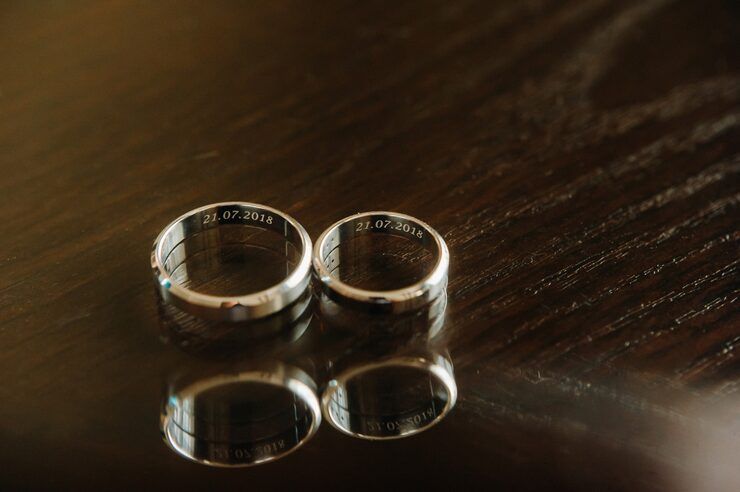
Most jewellery palladium is used as an alloy rather than in completely pure form. A widely recognised jewellery standard is 950 palladium, meaning the alloy contains 950 parts palladium per 1,000 parts by mass, or approximately 95% palladium. UK assay guidance identifies 950 as the most common palladium jewellery fineness.
Why Palladium Is Used in Rings
Palladium has several characteristics that influence how rings are designed and worn.
- Naturally white appearance: Palladium has a white metallic colour that does not depend on a surface coating to create its basic appearance.
- Lightweight structure: Palladium has a lower density than platinum, which can make a ring feel lighter on the finger.
- Durability: Palladium alloys can provide the strength needed for many everyday jewellery applications.
- Corrosion resistance: The metal is resistant to oxidation and corrosion under ordinary conditions.
- Alloy flexibility: Palladium can be combined with other metals to produce alloys with suitable characteristics for jewellery manufacture.
- Compatibility with gemstones: Palladium rings can be designed with diamonds and other gemstones, depending on the setting and construction.
The choice of metal still depends on the intended design, wearing habits, finger size, gemstone arrangement, and maintenance requirements.
Common Palladium Ring Types
Palladium rings appear in several design categories. Simple bands are among the most straightforward forms because they highlight the colour and surface of the metal without requiring complex decoration.
| Ring Type | Typical Characteristics | Common Use |
|---|---|---|
| Plain palladium band | Smooth or lightly textured surface | Wedding and everyday wear |
| 950 palladium ring | High-palladium alloy | Fine jewellery |
| Palladium engagement ring | Often includes a gemstone setting | Engagement jewellery |
| Palladium wedding ring | Usually designed as a band | Wedding jewellery |
| Palladium and gemstone ring | Palladium combined with a stone | Decorative jewellery |
| Contemporary palladium ring | Modern shapes and finishes | Fashion-oriented jewellery |
Why Palladium Rings Matter Today
The importance of palladium rings is connected partly to changing preferences for white precious metals. Consumers and designers increasingly have access to alternatives to traditional yellow gold and platinum, allowing jewellery to be selected according to appearance, weight, material characteristics, and design requirements.
Palladium can also be relevant for people who prefer a naturally white metal rather than a coloured surface finish. However, material selection should not be based on appearance alone. Purity information, alloy composition, manufacturing quality, ring construction, and applicable standards all affect the characteristics of an individual piece.
For jewellery manufacturers and designers, understanding palladium metallurgy is particularly important because palladium alloys behave differently from gold, silver, and platinum alloys during manufacturing and finishing.
950 Palladium and Purity
The term 950 palladium refers to fineness rather than a particular design. The number represents parts per thousand of palladium in the alloy.
For example:
- 950 palladium = 95% palladium
- 50 parts per thousand = other alloying elements
- Higher fineness generally indicates a greater proportion of palladium.
- The remaining elements help achieve suitable physical and manufacturing characteristics.
International hallmarking systems recognise several palladium fineness levels. The International Hallmarking Convention recognises 500, 950, and 999 palladium finenesses.
This should not be confused with India's current BIS hallmarking system. BIS states that its Indian hallmarking framework currently covers gold and silver, not palladium.
Recent Developments and Jewellery Trends
Recent developments in precious-metal regulation have focused strongly on traceability and consumer protection. In India, one of the most important developments was the introduction of HUID-based hallmarking for silver jewellery on a voluntary basis from 1 September 2025, alongside the revised IS 2112:2025 standard.
This change is significant for the broader jewellery sector because it demonstrates the continuing expansion of digital identification and traceability practices. It does not, however, mean that palladium rings automatically became subject to Indian BIS hallmarking.
Another important update occurred on 2 March 2026, when the sixth phase of India's mandatory gold hallmarking programme took effect. Seven additional districts were added, bringing the reported total to 380 districts.
These developments show a wider movement toward clearer identification of precious-metal articles. For palladium jewellery in India, consumers should therefore distinguish between general precious-metal information, international hallmarking systems, and the specific metals currently covered by Indian BIS requirements.
Laws and Policies Affecting Palladium Rings in India
India's hallmarking framework operates under the BIS Act, 2016 and the BIS (Hallmarking) Regulations, 2018. BIS explains that hallmarking is intended to establish and record the proportion of precious metal in covered articles.
At present, BIS states that gold and silver are the precious metals brought under India's hallmarking scheme. Palladium is therefore not currently covered in the same mandatory BIS jewellery hallmarking framework.
This distinction is important when evaluating a palladium ring in India. A purchaser should not assume that a palladium item must carry a BIS HUID simply because gold jewellery normally does.
For international jewellery, rules can be different. For example, the United Kingdom has legally recognised palladium hallmarking, with 950 being one of the recognised fineness standards. UK guidance states that palladium articles above the applicable weight exemption generally require hallmarking.
Therefore, the country in which a ring is manufactured, hallmarked, imported, or supplied can affect which identification and purity rules apply.
Tools and Resources for Palladium Rings
Several reliable resources can help readers research palladium jewellery and understand applicable standards.
- Bureau of Indian Standards (BIS): Useful for checking India's current hallmarking framework, standards, registered jewellers, and recognised Assaying & Hallmarking Centres.
- BIS CARE App: The app includes HUID verification for applicable hallmarked jewellery, particularly gold and newer silver HUID articles.
- BIS standards database: Useful when researching Indian Standards connected with precious metals and jewellery testing.
- UK Assay Office resources: Helpful for understanding international palladium fineness and hallmark structures.
- Ring-size standards: International jewellery standards such as ISO 8653 address ring-size definitions and measurement. BIS records IS 15892 as the corresponding Indian Standard.
A basic comparison can also help when researching materials:
| Feature | Palladium | Platinum | White Gold |
|---|---|---|---|
| Natural colour | White | White | Usually alloy-dependent |
| Common jewellery use | Rings and fine jewellery | Rings and fine jewellery | Rings and other jewellery |
| Typical hallmarking context | Depends on country | Depends on country | Widely established |
| Density | Relatively light | Relatively heavy | Varies by alloy |
| Surface appearance | Naturally white | Naturally white | May use additional surface finishing |
Frequently Asked Questions
Is palladium suitable for everyday rings?
Palladium can be suitable for everyday rings because appropriate palladium alloys provide durability and resistance to corrosion. The actual performance depends on alloy composition, ring construction, and how the jewellery is worn.
What does 950 mean on a palladium ring?
A 950 designation generally means that the alloy contains 950 parts palladium per 1,000 parts, equivalent to approximately 95% palladium. The remaining portion consists of other alloying elements.
Are palladium rings hallmarked in India?
India's BIS hallmarking scheme currently covers gold and silver rather than palladium. Therefore, a palladium ring should not automatically be expected to have a BIS HUID in the same way as applicable hallmarked gold jewellery.
Is palladium the same as platinum?
No. Both belong to the platinum-group metals and share some characteristics, but they are different chemical elements with different densities, physical properties, alloy compositions, and market applications.
How can the purity of a palladium ring be checked?
The appropriate testing method depends on the country and applicable standards. Professional precious-metal testing can determine composition more reliably than judging a ring by appearance or markings alone. UK assay guidance, for example, describes independent testing before palladium hallmarking.
Conclusion
Palladium rings represent a distinct category of precious-metal jewellery, combining a naturally white appearance with a relatively lightweight structure and useful durability. The widely recognised 950 palladium standard is particularly important when researching purity and international jewellery specifications.
In India, it is essential to distinguish palladium from gold and silver because the current BIS hallmarking framework covers gold and silver, while palladium is not presently included. Recent developments in 2025 and 2026 nevertheless show that India's jewellery regulations are continuing to strengthen traceability and identification across covered precious metals.