Power tillers are compact agricultural machines designed to perform several field operations that traditionally require significant manual or animal effort.
They are particularly useful for small and fragmented farms, vegetable cultivation, orchards, wetland preparation, and areas where larger agricultural machinery may be difficult to operate.
Unlike conventional tractors, power tillers are generally smaller, two-wheeled machines operated from behind. Depending on their configuration and attachments, they can support operations such as soil preparation, weeding, puddling, planting, interculture, and transportation.
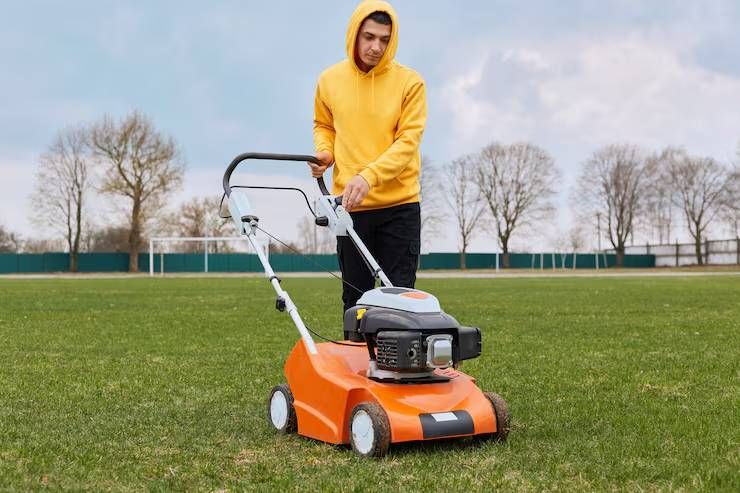
Understanding Power Tillers
A power tiller normally consists of an engine, transmission system, rotary tilling unit, wheels, handlebars, clutch and control mechanisms. Different implements can be attached according to the agricultural operation.
Common applications include:
- Primary and secondary soil preparation
- Seed-bed preparation
- Wetland and puddling operations
- Inter-row cultivation and weeding
- Planting and sowing with compatible equipment
- Ridging and furrowing
- Hauling with approved trailers
- Horticultural and vegetable-field operations
Power tillers are available with different engine capacities and configurations. The appropriate specification depends on soil type, crop, field size, terrain, operating depth, and the implement being used.
The Indian Council of Agricultural Research has also documented power-tiller-operated equipment capable of combining tillage and planting operations in a single field pass. One ICAR example is designed for a 7.5–9.0 kW power tiller and can simultaneously perform tilling and planting.
Why Power Tillers Matter in Modern Agriculture
Agricultural mechanization is important because farming operations can involve substantial physical effort and time. Mechanization can help reduce repetitive manual work and improve the consistency of certain field operations.
This is especially relevant in India, where farm holdings can be relatively small and fragmented. Large tractors may not always be practical in narrow fields, orchards, vegetable plots, terraces, or areas with difficult access.
Power tillers can address some of these challenges because of their compact dimensions and ability to operate with multiple implements.
Their importance can be considered in several areas:
- Small and fragmented farms: Compact machinery can be more suitable for smaller plots.
- Horticulture: Narrow spaces between crop rows may require smaller equipment.
- Wetland cultivation: Specialized rotary systems can be used for puddling and soil preparation.
- Labour efficiency: Mechanized operations can reduce dependence on intensive manual field work.
- Multiple applications: One machine can support different operations when compatible implements are available.
- Custom mechanization: Farmers who do not operate machinery individually may access equipment through organized farm machinery centres.
India's agricultural mechanization level varies considerably by crop and operation. Government data published in July 2025, based on ICAR estimates for 2020–21, reported average mechanization levels of about 70% for seed-bed preparation, 40% for sowing and planting, 33% for weeding and interculture, and 34% for harvesting and threshing, with an overall average of about 45%.
| Agricultural operation | Approx. mechanization level reported by ICAR estimates |
|---|---|
| Seed-bed preparation | 70% |
| Sowing, planting and transplanting | 40% |
| Weeding and interculture | 33% |
| Harvesting and threshing | 34% |
| Overall average | 45% |
These figures show why machinery suited to different farm operations continues to be relevant. They also demonstrate that mechanization is not uniform across the agricultural cycle.
Recent Developments and Trends
Farm mechanization has continued to receive policy attention during 2025 and 2026. Government programs have increasingly emphasized access to machinery for small and marginal farmers, custom hiring infrastructure, testing, training, and technology adoption.
In July 2026, the Government of India reported that the Sub-Mission on Agricultural Mechanization had supported the distribution of 21.61 lakh agricultural machines to individual farmers since its inception, alongside support for 27,554 Custom Hiring Centres, 646 high-tech hubs, and 25,608 Farm Machinery Banks.
The same policy direction places greater emphasis on improving access in underserved regions and among groups that may face difficulties in adopting agricultural machinery individually.
Another development is the increasing integration of conventional machinery with newer agricultural technologies. Government information published in August 2026 identifies precision agriculture, sensors, artificial intelligence, Internet of Things technologies, remote sensing, robotics and digital tools as growing components of agricultural technology.
For power tillers, this broader trend can mean greater attention to:
- Improved implement compatibility
- Better operator safety
- More efficient engines and transmissions
- Improved performance testing
- Mechanized planting and interculture
- Equipment suitable for horticulture and small farms
- Greater access through custom hiring models
The Central Farm Machinery Training & Testing Institute in Budni also maintains information on tested agricultural machines and subsidized machinery lists, including power tillers. Its machinery information was updated in May 2026.
Government Programs and Regulations
In India, power tillers are part of the wider agricultural mechanization framework. The Sub-Mission on Agricultural Mechanization, implemented through the Department of Agriculture and Farmers Welfare and State Governments, supports access to agricultural machinery and related infrastructure.
The program also supports Custom Hiring Centres and Farm Machinery Banks. This approach is intended to improve access where individual ownership of agricultural machinery may not be practical.
The official agricultural mechanization portal provides information on applications, machinery categories, state-level implementation, beneficiary processes, reports and assistance calculations. Requirements can vary by state, financial year, farmer category and machinery category.
For the 2026–27 financial year, the official portal shows that state-specific application windows and processes may differ. For example, Kerala's portal information in September 2026 listed an online application period for a particular SMAM lottery from September 22 to October 15, 2026. This illustrates why users should check their state's current notification rather than relying on an older schedule.
Technical standards are another important consideration. BIS lists IS 13539:2018 for power tillers, covering selected performance and other characteristics. BIS information identifies areas such as engine performance, drawbar performance, rotary shaft performance, braking, noise, wetland cultivation, safety features and labelling within the testing framework.
Power tiller testing is also conducted through the Central Farm Machinery Training & Testing Institute. The institute provides testing procedures and application documentation for power tillers, including commercial and related testing requirements.
When a power tiller is operated with a trailer or used in circumstances covered by motor-vehicle requirements, additional technical and road-safety requirements may apply. CFMTTI documentation references relevant Central Motor Vehicle Rules for components and characteristics of power tillers coupled with trailers.
Tools and Resources for Power Tiller Users
Several official resources can help farmers, agricultural professionals, manufacturers, researchers and machinery operators understand equipment requirements.
- Agricultural Mechanization DBT Portal: Provides information on machinery assistance, applications, state programs, reports and related processes.
- Assistance Calculator: The official portal provides a calculator for determining applicable assistance based on selected state, scheme, farmer category, implement and other inputs.
- BIS Know Your Standard: Allows users to search Indian Standards by standard number or product keyword and access related standard information.
- CFMTTI Testing Resources: Provides testing forms, checklists and technical information for power tillers.
- ICAR Agricultural Engineering Resources: Provides technical information about agricultural implements and power-tiller-operated equipment.
- Farm Machinery Reports: The agricultural mechanization portal provides reports, guidelines and machinery-related information for different financial years.
When comparing power tiller specifications, users should consider engine power, transmission, working width, operating depth, wheel configuration, implement compatibility, fuel type, safety features and field conditions rather than relying on a single specification.
| Specification area | Why it matters |
|---|---|
| Engine power | Influences the machine's ability to operate different implements |
| Working width | Affects the area covered during each pass |
| Rotary system | Determines suitability for particular soil operations |
| Transmission | Controls available operating speeds and torque |
| Weight and dimensions | Important for transport and maneuverability |
| Implement compatibility | Determines the range of agricultural tasks |
| Safety equipment | Supports safer operation |
| Testing documentation | Helps assess declared technical performance |
Frequently Asked Questions
What is a power tiller?
A power tiller is a compact agricultural machine generally operated from behind using handlebars. It is designed for soil preparation and can work with different agricultural implements for operations such as tilling, weeding, planting and interculture.
How is a power tiller different from a tractor?
A power tiller is generally smaller and is operated from behind rather than from a tractor seat. Its compact design can make it suitable for smaller fields, narrow spaces, horticultural areas and some terrain where larger machinery may be difficult to maneuver.
What operations can a power tiller perform?
Depending on its configuration and attachments, a power tiller can support soil preparation, puddling, weeding, interculture, ridging, furrowing, planting and other agricultural operations. The actual capability depends on the machine and compatible implement.
Are power tillers covered by Indian standards?
Yes. BIS identifies IS 13539:2018 as a standard covering selected performance and other characteristics for power tillers. Testing institutions such as CFMTTI also provide specific testing procedures and documentation.
Is government assistance available for agricultural machinery?
Government assistance may be available under agricultural mechanization programs, but eligibility, machinery categories, assistance levels and application procedures can vary by state, financial year and beneficiary category. The official agricultural mechanization portal should be checked for current requirements.
Conclusion
Power tillers occupy an important place in India's agricultural mechanization landscape, particularly where compact and versatile machinery is useful. Their applications extend beyond basic soil preparation to planting, interculture, horticulture and other field operations when suitable implements are used.
Recent government initiatives have continued to expand agricultural mechanization infrastructure, including Custom Hiring Centres, Farm Machinery Banks, testing facilities and digital application systems. At the same time, technical standards and testing procedures provide a framework for evaluating machine performance and safety.