Red rubies are among the best-known colored gemstones and have been valued for their strong red color, durability, and long history in jewelry and ornamentation.
A ruby is the red variety of the mineral corundum, the same mineral family that includes sapphire. Its red color is mainly associated with the presence of chromium.
Rubies occur naturally in several parts of the world, including Myanmar, Mozambique, Sri Lanka, Vietnam, Tanzania, and other geological regions. Natural stones can vary considerably in color, transparency, inclusions, size, and treatment history. Laboratory-grown rubies also exist and have the same basic chemical composition and crystal structure as natural ruby, although their origin is different.
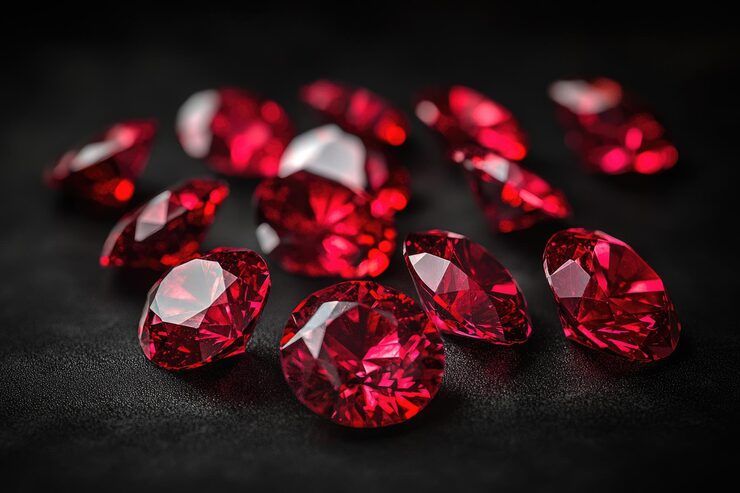
Understanding these differences is important because the appearance of a ruby alone does not always reveal whether it is natural, treated, or laboratory-grown.
What Makes a Ruby Red?
The characteristic red color of ruby is primarily linked to chromium within the corundum crystal structure. The intensity of the color can range from relatively light red to deep red and slightly purplish red.
Gemological organizations generally consider color the most important quality factor for ruby. Fine examples tend to have vivid red color with strong saturation without appearing excessively dark.
The traditional expression "pigeon’s blood" is sometimes used in the gemstone trade for certain highly desirable red colors. However, terminology of this kind can be interpreted differently, and it should not be treated as a substitute for laboratory identification or a complete description of a gemstone.
Why Red Rubies Matter Today
Red rubies remain important in jewelry, gemology, mineral research, and the study of colored gemstones. Their importance comes from several characteristics:
- Distinctive color: Ruby is recognized for its red to slightly purplish-red appearance.
- Durability: Ruby has a Mohs hardness of 9, making it suitable for many types of jewelry.
- Scientific interest: Natural inclusions can provide information about the stone's geological formation and treatment history.
- Cultural significance: Rubies have appeared in jewelry, royal collections, religious objects, and historical ornaments for centuries.
- Technological applications: Synthetic ruby has also been used in areas such as laser technology and other technical applications.
For consumers, collectors, gemologists, designers, and researchers, distinguishing between natural and laboratory-grown material and understanding treatments are important parts of evaluating ruby.
Main Ruby Quality Factors
Ruby quality is not determined by a single characteristic. Gemological assessment considers several factors together.
| Quality factor | What it describes | Why it matters |
|---|---|---|
| Color | Hue, tone, and saturation | Usually the most important visual factor |
| Clarity | Internal inclusions and fractures | Can affect transparency and appearance |
| Cut | Shape, proportions, and faceting | Influences light return and visual appearance |
| Carat weight | Weight of the gemstone | Larger fine-quality rubies are uncommon |
| Treatment | Heating, filling, diffusion, or other processes | Helps explain the stone's characteristics |
| Origin | Geological source, when determinable | May provide additional gemological information |
Color is generally the most significant quality factor. Clarity is considered differently for ruby than for diamonds because natural ruby commonly contains inclusions. Some inclusions can even contribute to the appearance of a gemstone.
Fine-quality rubies weighing more than one carat are relatively rare, while smaller and commercially produced stones occur in a much broader range of sizes.
Natural, Treated, and Laboratory-Grown Rubies
A natural ruby forms through geological processes. A laboratory-grown ruby is produced under controlled conditions and has essentially the same basic chemical and physical characteristics as natural ruby.
Treatment is another separate issue. Many natural rubies have been heat-treated to improve their color or clarity. Other treatments can include diffusion or fracture filling. These processes should be identified when detected because they affect how the gemstone should be understood and cared for.
GIA notes that most rubies encountered in the market have been heated and recommends obtaining treatment information in writing. Independent laboratory reports can identify whether a ruby is natural or laboratory-grown and can disclose detectable treatments.
Recent Developments and Updates
The ruby field continues to be influenced by improved laboratory testing, growing interest in colored gemstones, and greater attention to treatment disclosure.
In India, recent regulatory developments have mainly concerned precious-metal jewelry rather than the ruby mineral itself. The Bureau of Indian Standards (BIS) continues to maintain the country's hallmarking framework for gold and silver articles. Its current information confirms that hallmarking applies to these two precious metals, rather than to gemstones such as ruby.
A significant recent development is that BIS's mandatory hallmarking framework has continued to receive amendments. BIS lists amendments dated July 31, 2025; March 2, 2026; April 28, 2026; and August 3, 2026 on its mandatory hallmarking page. These changes relate to the regulatory coverage of gold jewelry and artifacts rather than establishing a separate ruby hallmark.
BIS also published a Hallmarking of Gold Jewellery and Gold Artefacts (Second Amendment) Order, 2026, on May 8, 2026.
These developments matter when a ruby is mounted in gold jewelry because the gemstone and the precious-metal setting are subject to different forms of identification and regulation.
Laws and Policies Affecting Rubies in India
India's hallmarking system is administered by the Bureau of Indian Standards. Hallmarking establishes the purity or fineness of precious-metal articles and currently covers gold and silver. It does not certify a ruby's natural origin, treatment status, color, or geological source.
For gold jewelry containing a ruby, the hallmark relates to the gold article rather than confirming the identity of the gemstone. Current BIS information states that hallmarked gold jewelry carries the BIS logo, the purity or fineness indication, and a six-digit Hallmark Unique Identification (HUID) number. Consumers can verify HUID information through the BIS Care app.
BIS also states that invoices for hallmarked precious-metal articles should contain relevant information such as the description of the article, net precious-metal weight, purity, fineness, and applicable hallmarking information.
This distinction is useful: a gold hallmark is not a ruby certification. For information about whether a gemstone is natural, laboratory-grown, treated, or potentially from a particular geographic origin, a specialized gemological laboratory report is more relevant.
Tools and Resources for Ruby Research
Several resources can help readers understand and document ruby characteristics:
- GIA Ruby Research: Provides educational information about ruby color, clarity, cut, carat weight, treatments, and origin.
- GIA Colored Stone Reports: Can identify whether a ruby is natural or laboratory-grown and disclose detectable treatments.
- BIS Hallmarking Resources: Useful for understanding gold and silver purity requirements when a ruby is mounted in precious-metal jewelry.
- BIS Care App: Includes a HUID verification function for applicable hallmarked gold jewelry.
- Gemological microscope: Used by trained professionals to examine inclusions and growth characteristics.
- Refractometer and spectroscope: Professional gemological instruments that can assist in identifying corundum and studying its optical characteristics.
- Laboratory reports: Useful when natural origin, treatment status, or other gemological characteristics need independent documentation.
Caring for Red Rubies
Ruby is relatively hard and durable, but the appropriate care depends partly on treatment.
For untreated or appropriately treated ruby, warm soapy water is generally considered a safe cleaning method. However, fracture-filled, cavity-filled, or dyed material may require more careful handling. GIA specifically advises that filled or dyed ruby should be cleaned with a damp cloth rather than exposed to aggressive cleaning methods.
Heat, chemicals, sudden environmental changes, and inappropriate cleaning equipment can be problematic for certain treated gemstones. Knowing the treatment history is therefore an important part of gemstone care.
Frequently Asked Questions
What is a red ruby?
A red ruby is the red variety of corundum, a mineral composed primarily of aluminum oxide. Chromium is the principal element responsible for ruby's characteristic red color.
How can natural ruby be distinguished from synthetic ruby?
Visual inspection alone may not always provide a reliable answer. Gemologists examine inclusions, growth structures, optical characteristics, and other features using specialized equipment. A laboratory report can provide independent identification.
Are all rubies untreated?
No. Many rubies have undergone heat treatment, and other treatments such as diffusion and fracture filling are also encountered. Treatment disclosure is therefore an important part of ruby identification.
Does a gold hallmark certify the ruby in a ring?
No. A BIS hallmark relates to the purity or fineness of the precious-metal article, such as gold or silver. It does not establish that the mounted ruby is natural, untreated, or from a particular geographic location.
What is the best way to document a ruby's characteristics?
An independent gemological laboratory report is one of the most useful forms of documentation. Depending on the laboratory and report type, it can identify whether the ruby is natural or laboratory-grown, describe its characteristics, identify detectable treatments, and in suitable cases provide an opinion regarding geographic origin.
Conclusion
Red rubies combine distinctive color, mineral durability, geological history, and cultural importance. Their appearance can be influenced by natural formation, inclusions, cutting, heat treatment, diffusion, or fracture filling, while laboratory-grown rubies provide an important example of how modern technology can reproduce the characteristics of a natural mineral.
For people studying ruby gemstones, the most useful approach is to separate color, clarity, cut, carat weight, treatment, origin, and identification rather than relying on a single description. In India, it is also important to distinguish gemstone documentation from precious-metal hallmarking. BIS hallmarking provides information about applicable gold or silver articles, while gemological laboratories address questions about the gemstone itself.