Virtual reality (VR) hardware and interfaces are the physical devices and interaction systems that allow people to enter and interact with computer-generated environments.
A typical VR system can include a head-mounted display, motion controllers, cameras, tracking sensors, audio equipment, and software that connects these components.
The purpose of VR hardware is to create a sense of presence by presenting stereoscopic images and responding to a user's movements. Modern systems can track head position, hand movements, eye direction, and body movement. Some devices also use cameras for spatial awareness and passthrough, allowing users to see their physical surroundings while viewing digital information.
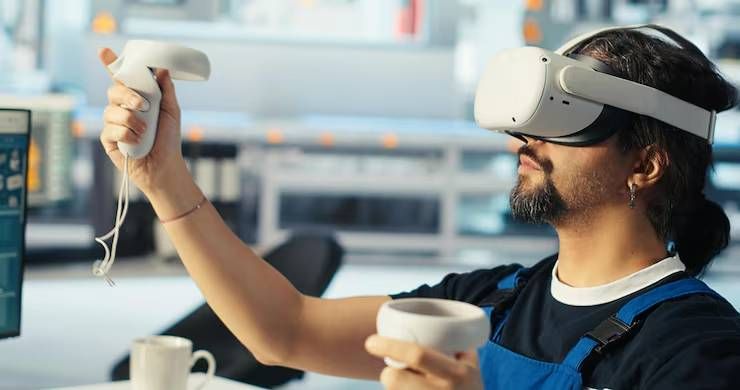
VR interfaces have developed from simple controller-based systems into more natural interaction methods. Hand tracking, eye tracking, voice commands, gesture recognition, and spatial mapping are increasingly important parts of virtual reality hardware and interface technology.
Why VR Hardware and Interfaces Matter
VR hardware has applications across entertainment, education, healthcare, engineering, training, architecture, manufacturing, research, and other fields. Its importance comes from the ability to represent three-dimensional environments in a way that can be explored rather than viewed only on a conventional screen.
For education and training, immersive environments can provide simulations of locations, equipment, procedures, or situations that may be difficult to reproduce physically. In industrial environments, VR can support design visualization, training simulations, and digital prototypes.
Healthcare is another growing area. In May 2025, ISO published ISO/TS 16551:2025, a reference model for VR-based clinical practice simulation. The standard addresses the components, relationships, data elements, and user roles involved in clinical VR simulation.
The main components of VR hardware include:
- Head-mounted displays: Present stereoscopic visual content directly in front of the user's eyes.
- Motion tracking: Determines the position and movement of the user's head, hands, or other tracked objects.
- Controllers: Provide physical buttons, triggers, and movement inputs.
- Hand tracking: Uses cameras and computer vision to detect hand positions and gestures.
- Eye tracking: Measures eye movement and can support interface navigation and rendering techniques.
- Spatial audio: Creates directional sound that corresponds with the virtual environment.
- Passthrough cameras: Display the physical environment through cameras while digital content is presented alongside it.
- Haptic systems: Provide physical feedback through vibration or other forms of tactile response.
Key Hardware and Interface Comparison
| Component | Main Function | Common Interface |
|---|---|---|
| VR headset | Displays immersive visual content | Head movement, eye tracking |
| Motion controller | Provides precise interaction | Buttons, triggers, movement |
| Hand tracking | Detects hand and finger movement | Gestures |
| Eye tracking | Detects gaze direction | Gaze selection |
| Spatial audio | Positions sounds within an environment | Head movement and audio cues |
| Passthrough cameras | Shows the physical surroundings | Visual interaction |
| Haptic hardware | Provides tactile feedback | Touch and vibration |
The quality of a VR experience depends on how these components work together. Display resolution, field of view, refresh rate, latency, tracking accuracy, processing capability, ergonomics, and interface design all influence usability.
Recent Developments in VR Hardware
VR hardware continued to evolve during 2025 and 2026, with greater attention to lightweight designs, natural interfaces, mixed reality, developer tools, and artificial intelligence.
In February 2026, Meta stated that it was maintaining a strong focus on VR hardware while adjusting its broader Reality Labs strategy. The company said its future headset roadmap would address different user groups as the VR market develops.
At GDC 2026 in March, Meta highlighted improvements in development workflows, performance tools, AI-assisted iteration, hand tracking, and the wider VR developer ecosystem. Meta also reported that more people used Meta Quest in 2025 than in any previous year for its platform.
Another important development came in September 2026. Meta introduced Meta VR Glasses as a new form factor based on its Horizon operating system. The company described eye and hand input as primary interaction methods, with the devices designed around a glasses-style form factor rather than a conventional enclosed headset. The devices are planned for spring 2027, while development tools were made available in 2026.
These developments show several broader trends:
- Smaller and lighter wearable designs
- Greater use of hand and eye tracking
- Increased integration of artificial intelligence
- More capable passthrough and mixed-reality functions
- Greater attention to comfort and accessibility
- Development tools that support faster testing and optimization
- Movement toward interfaces that require fewer physical controllers
VR interfaces are also becoming more diverse. Controllers remain useful for precise interaction, while hand tracking and eye tracking can make simple navigation more natural. The appropriate interface depends on the application, environment, accuracy requirements, and user's physical abilities.
Laws, Standards, and Policies in India
VR hardware in India can be affected by several areas of regulation, including electronics standards, wireless communication requirements, data protection, and consumer safety.
One important recent development is the inclusion of Extended Reality Products, covering augmented reality, virtual reality, and mixed reality products, within India's compulsory registration framework under the relevant electronics and IT goods requirements. BIS records show the migration to IS/IEC 62368-1:2023 for this product category was notified on November 4, 2025, with a further amendment dated March 10, 2026.
For VR equipment containing wireless communication functions, India's Wireless Planning & Coordination Wing can also be relevant. The Department of Telecommunications states that Equipment Type Approval applies to wireless communication devices operating in permitted licence-exempt frequency bands or involving RF transmission.
Data protection is another consideration because VR systems can potentially process information associated with users, accounts, interactions, and other digital activity. India's Digital Personal Data Protection Rules, 2025, were notified by the Ministry of Electronics and Information Technology in November 2025.
International standards also influence the design and use of VR systems. ISO/IEC 5927:2024 provides guidance covering safe setup and usage of AR and VR systems, including safe immersion and workplace safety considerations.
Accessibility is also becoming more important. ISO/IEC 40500:2025 adopted WCAG 2.2 as an international standard in September 2025, providing a broader framework for accessible digital content.
These rules and standards do not mean that every VR headset is governed by one single regulation. Requirements can vary according to the device's features, wireless capabilities, intended use, data processing, and classification.
Tools and Resources for VR Hardware and Interfaces
Several development platforms and technical resources can help users, researchers, educators, and developers understand VR hardware and interface technology.
- OpenXR: An open standard designed to help applications work across different XR hardware and platforms.
- Meta Horizon developer resources: Documentation, device information, SDKs, and development guidance for compatible Meta XR devices.
- Unity: A widely used development environment for creating interactive 3D and VR applications.
- Unreal Engine: A real-time 3D development platform used for immersive applications, simulations, and visualization.
- WebXR: Web-based technology that allows compatible browsers to provide immersive and augmented experiences.
- SteamVR: A widely used software platform for compatible PC-based VR hardware.
- BIS Know Your Standard: India's official BIS portal for searching Indian Standards, amendments, notifications, testing information, and related certification details.
- DoT Equipment Type Approval resources: Official information for checking applicable wireless equipment requirements in India.
- NIST immersive technology research: NIST resources include research on cybersecurity, privacy, and human factors associated with immersive technologies.
When evaluating a VR system, users should consider display quality, tracking method, interface options, computing requirements, physical comfort, software compatibility, privacy features, and applicable standards rather than focusing on one specification alone.
Frequently Asked Questions
What is VR hardware?
VR hardware refers to the physical equipment used to create and interact with virtual reality environments. It commonly includes a headset, tracking sensors or cameras, controllers, audio equipment, and sometimes additional haptic or body-tracking devices.
What is a VR interface?
A VR interface is the method through which a person interacts with digital content inside a virtual environment. Examples include controllers, hand gestures, eye movement, voice commands, and physical movement.
Is eye tracking necessary for VR?
No. Eye tracking is an additional interface and sensing technology rather than a requirement for every VR system. Some applications can operate entirely through controllers, hand tracking, head movement, or other inputs.
How is VR hardware regulated in India?
Depending on the device and its functions, VR hardware can be subject to Indian electronics standards and compulsory registration requirements. Wireless capabilities can also bring Department of Telecommunications requirements into consideration. Extended Reality Products were specifically included in the relevant BIS compulsory registration framework in 2025, with subsequent changes in 2026.
What are the main challenges with VR interfaces?
Common challenges include motion discomfort, tracking limitations, physical fatigue, accessibility, privacy concerns, device weight, battery limitations, and the learning curve associated with unfamiliar interaction methods. Good interface design attempts to reduce unnecessary movement and provide clear feedback.
Conclusion
VR hardware and interfaces are moving beyond traditional headsets and handheld controllers toward systems that combine visual displays, spatial tracking, cameras, hand recognition, eye tracking, artificial intelligence, and mixed-reality capabilities.
Developments during 2025 and 2026 indicate continued work on lighter form factors, natural interaction, developer tools, and broader applications. At the same time, safety, accessibility, privacy, and technical standards are becoming increasingly important as immersive technology reaches more areas.