Water jet cutting machines are industrial systems that use a high-pressure stream of water to cut materials into specific shapes and dimensions.
Depending on the material, the system may use pure water or mix water with abrasive particles to improve cutting performance. These machines are used in manufacturing environments where accuracy, material flexibility, and controlled cutting processes are important.
Unlike conventional cutting methods that rely on a rotating blade, mechanical contact, or a concentrated heat source, water jet cutting removes material through the force of a narrow, high-velocity stream. This makes the technology useful for processing metals, plastics, rubber, glass, stone, ceramics, and selected composite materials.
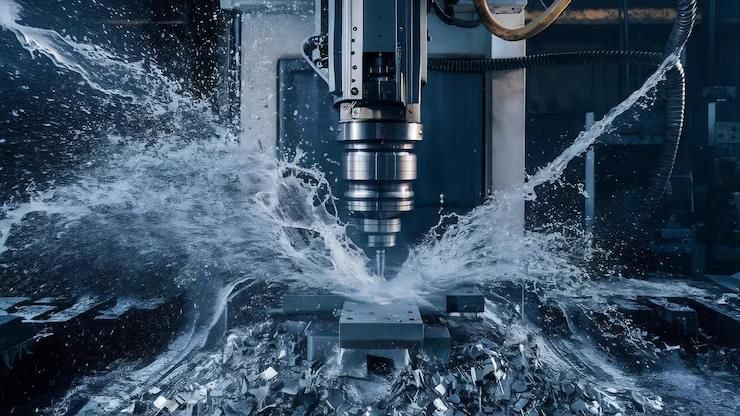
A typical industrial waterjet system consists of a high-pressure pump, cutting head, nozzle, motion-control equipment, material support table, and a control interface. Computer numerical control (CNC) systems guide the cutting head along a programmed path to produce the required shape.
Water jet cutting technology has developed alongside advances in industrial automation, computer-aided design (CAD), and digital manufacturing. Modern systems can integrate programmed cutting paths, automated material positioning, and process monitoring to support repeatable production.
Why Water Jet Cutting Matters in Modern Manufacturing
Manufacturers work with materials that vary in thickness, hardness, sensitivity to heat, and structural composition. Selecting an appropriate cutting process can affect product quality, material waste, production time, and the amount of finishing required.
Water jet cutting addresses several manufacturing challenges because it removes material without relying on a conventional heat-generating cutting mechanism. It can be especially useful when thermal distortion, heat-affected zones, or changes to a material's local properties are concerns.
The technology is relevant to several groups:
Manufacturing engineers: They evaluate cutting accuracy, machine capacity, production requirements, and material compatibility.
Fabrication companies: They use waterjet systems to produce components from metal sheets, plates, and other industrial materials.
Aerospace and automotive manufacturers: They process selected metals, composites, and engineered components according to application-specific requirements.
Stone and architectural fabricators: They cut patterns and profiles in stone, tile, and other suitable materials.
Research and product-development teams: They use programmable cutting methods to create prototypes and specialized components.
Waterjet cutting does not eliminate every manufacturing limitation. Cutting speed depends on material type, thickness, pressure, nozzle condition, and the required edge quality. Some applications also require secondary finishing or careful management of water-sensitive materials.
Main Water Jet Cutting Methods
The two primary approaches are pure waterjet cutting and abrasive waterjet cutting. Each method is suited to different material groups and operating requirements.
Pure waterjet cutting
Pure waterjet systems use a concentrated stream of pressurized water without added abrasive particles. They are commonly used for softer materials such as foam, textiles, paper, rubber, and certain food products when the equipment is designed for the application.
This method is useful when a relatively clean cut is needed without introducing abrasive material into the process. However, it is generally unsuitable for cutting thick, hard metals in the way abrasive waterjet systems can.
Abrasive waterjet cutting
Abrasive waterjet systems combine high-pressure water with abrasive particles, commonly garnet. The mixture creates a cutting stream capable of removing material from metals, stone, ceramics, glass, and many composites.
Abrasive waterjet cutting is widely used for industrial plate cutting, intricate profiles, and components that require limited thermal influence. Abrasive selection, feed rate, water pressure, and cutting-head condition influence the finished result.
Feature | Pure waterjet | Abrasive waterjet |
|---|---|---|
Cutting medium | High-pressure water | Water and abrasive particles |
Typical materials | Foam, textiles, rubber | Metals, stone, glass, ceramics |
Abrasive consumption | None | Required |
Common applications | Soft-material processing | Industrial fabrication |
Thermal cutting effects | No conventional heat-based cutting zone | No conventional heat-based cutting zone |
Waste management | Water and cut material | Water, abrasive residue, and cut material |
Both methods require suitable machine configuration, material support, operating procedures, and quality checks.
CNC Controls and Essential Machine Components
Computer numerical control is central to the operation of modern industrial waterjet cutting equipment. It translates digital designs into controlled movements that guide the cutting head across a workpiece.
The process usually begins with a CAD drawing. CAM software converts the design into cutting instructions, including the cutting path, feed rate, and other process parameters. The CNC controller then coordinates machine movement and communicates with relevant equipment systems.
Key components include:
High-pressure pump: Generates the pressure needed to produce the cutting jet.
Cutting head and nozzle: Direct and shape the water stream, with abrasive mixing where applicable.
CNC motion system: Controls the cutting head's position and movement.
CAD/CAM software: Supports design preparation, toolpath generation, and cutting sequence planning.
Abrasive delivery system: Regulates abrasive flow in systems designed for abrasive cutting.
Water filtration and collection system: Manages water quality and helps collect cutting residue.
Safety interlocks and emergency stops: Help prevent hazardous operation under specified conditions.
Advanced equipment may include multi-axis cutting heads, automated material handling, remote diagnostics, and sensors that monitor operating conditions. These features can support more complex cutting tasks, but their effectiveness depends on appropriate configuration, maintenance, and operator training.
Recent Developments and Industry Trends
During 2025 and 2026, waterjet cutting technology continued moving toward greater automation, improved digital control, and more integrated manufacturing workflows. These developments reflect manufacturers' interest in handling complex designs while monitoring quality and equipment performance.
A notable trend is the integration of CNC cutting equipment with robotic loading, unloading, and material positioning. Such configurations can reduce manual handling, although the overall result depends on production volume, system integration, and safety requirements.
Other developments include software-assisted nesting, remote equipment monitoring, improved abrasive management, and more efficient pump designs. Nesting software arranges component shapes on a sheet or plate to help reduce unused material. Monitoring tools can help identify abnormal operating conditions, while maintenance alerts can support planned servicing.
Industry reports published in 2026 also highlighted automation, robotic waterjet systems, digital controls, and resource efficiency as important areas of development. These are broad industry trends rather than evidence that every manufacturer has adopted the same technologies.
Key trends to watch include:
Multi-axis cutting: Supports angled edges and selected three-dimensional profiles.
Digital production planning: Connects design files, nesting, machine instructions, and production records.
Predictive maintenance: Uses equipment data to help identify developing faults.
Resource management: Focuses on water filtration, abrasive recovery where practical, and waste handling.
Connected manufacturing: Integrates cutting equipment with factory scheduling, inspection, and material handling.
These changes may improve process consistency, but actual performance depends on machine capability, material properties, maintenance, and operating conditions.
Laws, Regulations, and Industrial Safety in India
Water jet cutting machines used in India are affected by workplace safety requirements, environmental rules, electrical safety provisions, and applicable machinery standards. The exact obligations depend on the establishment, machine configuration, state-level requirements, and nature of the work.
The Occupational Safety, Health and Working Conditions Code, 2020 came into force on 21 November 2025, according to India's official government information. It consolidates provisions relating to occupational safety and working conditions. The associated Central Rules were notified in May 2026. Employers should consult the current legislation and applicable rules to determine their obligations.
For waterjet cutting operations, practical compliance considerations include:
Machine guarding and access control: Restrict access to hazardous moving components and high-pressure equipment.
Pressure-system safety: Follow the machine manufacturer's operating limits, inspection instructions, and maintenance procedures.
Worker training: Ensure operators understand startup, shutdown, emergency procedures, and safe material handling.
Personal protective equipment: Select appropriate eye, hearing, and other protection based on the documented risk assessment.
Electrical safety: Maintain suitable electrical installations, isolation procedures, and emergency-stop functions.
Wastewater and abrasive residue: Follow applicable requirements for discharge, solid waste handling, and disposal of contaminated material.
India's official legislation portal, India Code, provides access to statutes and legal documents. Businesses should verify current central and state requirements rather than assume that a general machine standard automatically establishes full compliance.
Tools and Resources for Waterjet Cutting
Several digital tools and technical resources help engineers, operators, and manufacturing teams plan cutting operations and maintain equipment.
Tool or resource | Main purpose |
|---|---|
CAD software | Creates accurate two-dimensional and three-dimensional component designs |
CAM and nesting software | Converts designs into cutting paths and arranges parts to manage material use |
CNC simulation software | Helps check toolpaths and identify potential programming issues before production |
Pressure and flow monitoring instruments | Support monitoring of pump performance and operating conditions |
Material compatibility guides | Help determine whether pure waterjet or abrasive cutting suits a particular material |
Equipment maintenance manuals | Provide inspection schedules, operating limits, and troubleshooting procedures |
India Code | Provides access to Indian legislation and statutory documents |
Frequently Asked Questions
What materials can water jet cutting machines process?
Depending on the system, they can process metals, stone, glass, ceramics, rubber, foam, plastics, textiles, and selected composites. Pure waterjet systems are generally suited to softer materials, while abrasive systems can cut many harder materials.
How does waterjet cutting differ from laser cutting?
Waterjet cutting uses a high-pressure stream of water, sometimes combined with abrasive particles. Laser cutting uses concentrated light energy. Waterjet cutting avoids the conventional heat-affected zone associated with thermal cutting, while laser cutting can provide higher speeds on certain thin materials. The appropriate method depends on material type, thickness, geometry, and required finish.
What role does CNC play in waterjet cutting?
CNC controls the cutting head's movement according to programmed instructions. When integrated with CAD/CAM software, it helps translate digital designs into repeatable cutting paths and manage complex shapes.
Are water jet cutting machines suitable for precision manufacturing?
Yes. They can produce detailed profiles and accurate components when the machine, cutting parameters, material support, and programming are appropriate. Actual tolerances depend on equipment capability, material thickness, nozzle condition, and the selected cutting process.
What maintenance do industrial waterjet systems require?
Common maintenance tasks include inspecting high-pressure components, checking nozzles and orifices, monitoring abrasive delivery, maintaining filtration systems, and following pump maintenance schedules. All servicing should follow manufacturer instructions and appropriate pressure-isolation procedures.
Conclusion
Water jet cutting machines are important tools in modern manufacturing because they can process diverse materials using pure water or abrasive-assisted cutting. Their applications extend across metal fabrication, automotive manufacturing, aerospace, architecture, and flexible-material processing.
Advances in CNC controls, multi-axis motion, production software, and automation are expanding how these machines fit into industrial workflows. At the same time, safe operation requires suitable training, regular maintenance, and compliance with applicable workplace and environmental regulations.
Understanding cutting methods, machine components, software tools, and material limitations helps manufacturers select appropriate processes and maintain consistent production quality. Waterjet technology remains one option within a broader range of industrial cutting methods, with its suitability determined by the specific application and manufacturing requirements.