Industrial automation combines mechanical equipment, electrical systems, digital technologies, and control software to perform repetitive or complex tasks.
Instead of requiring a person to control every operation manually, an automated system follows programmed instructions and responds to information collected from sensors.
For example, an automated packaging line can detect products on a conveyor, fill containers, apply labels, and check package positions. Sensors monitor each stage, while controllers coordinate equipment and respond to detected problems.
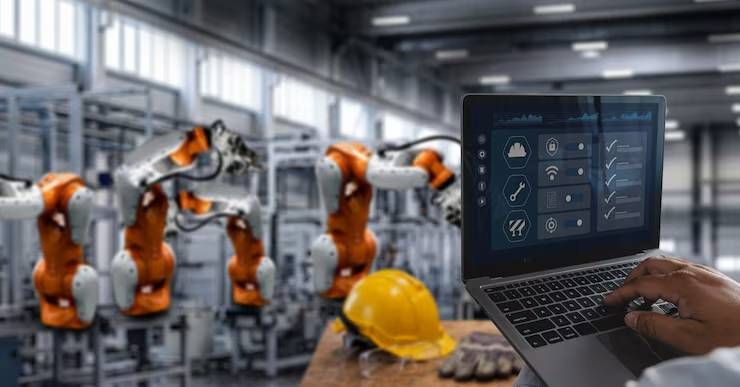
Industrial automation can range from a single automated machine to a connected production facility containing hundreds of machines and monitoring systems.
Common components include:
- Sensors: Measure variables such as temperature, pressure, speed, position, and liquid level.
- Actuators: Produce physical movement or actions, such as opening valves or moving mechanical parts.
- Programmable Logic Controllers (PLCs): Execute programmed instructions to control industrial equipment.
- Human-Machine Interfaces (HMIs): Allow operators to monitor systems and adjust permitted settings.
- Supervisory Control and Data Acquisition (SCADA): Supports supervisory monitoring and control across industrial processes.
- Industrial robots: Perform tasks such as welding, material handling, assembly, and inspection.
- Industrial networks: Connect controllers, sensors, machines, and monitoring platforms.
These components work together to monitor conditions, coordinate actions, and maintain production processes within defined operating limits.
Importance: Why Industrial Automation Matters
Production Consistency
Automated equipment can repeat programmed movements and operating sequences with consistent timing. This is particularly useful in manufacturing processes where product dimensions, filling quantities, temperature, or assembly positions must remain within specified limits.
Automation does not eliminate all defects. Incorrect programming, worn components, faulty sensors, or poor calibration can still cause problems. Regular inspection and quality checks remain necessary.
Operational Efficiency
Automation can reduce delays between production stages by coordinating machinery and monitoring process conditions. For example, a conveyor system can move components between workstations at a controlled rate, while sensors identify blockages or missing items.
Better coordination can also help production teams understand where interruptions occur and which equipment requires attention.
Workplace Safety
Robots and automated handling systems can perform certain tasks in environments involving high temperatures, heavy loads, hazardous chemicals, or repetitive movements.
However, automated machinery can introduce risks involving crushing, unexpected movement, electrical hazards, and maintenance activities. Safety guards, emergency stops, interlocks, risk assessments, and suitable training are essential.
Data-Based Decision-Making
Connected automation systems can record operating conditions, production quantities, equipment downtime, and alarm events. These records help engineers investigate recurring problems and evaluate process performance.
When data is accurate and properly interpreted, it can support maintenance planning, process adjustments, and quality improvement.
Types of Industrial Automation
Different automation approaches suit different production requirements.
| Type | Description | Typical Applications |
|---|---|---|
| Fixed automation | Equipment performs a predetermined sequence of operations | High-volume assembly and bottling lines |
| Programmable automation | Machines can be reprogrammed for different batches or products | Batch processing and machining |
| Flexible automation | Equipment changes between product variations with limited interruption | Automated assembly and mixed-product manufacturing |
| Integrated automation | Multiple machines and control systems operate as a coordinated system | Connected production facilities and integrated process plants |
Fixed automation is generally associated with stable, repeated production sequences. Programmable and flexible systems support greater variation, although their complexity depends on the equipment and production requirements.
Integrated automation describes coordination across systems and can include several of the other automation types.
Core Technologies Used in Industrial Automation
Programmable Logic Controllers
A PLC is an industrial computer designed to control machinery and processes. It receives signals from sensors, executes control logic, and sends commands to outputs such as motors, valves, and relays.
For example, a PLC can start a conveyor when a safety condition is satisfied and stop it when a sensor detects a full collection area. PLCs are widely used because they are designed for industrial environments and support predictable control behavior.
Sensors and Actuators
Sensors provide information about the physical environment. Temperature sensors, pressure transmitters, proximity sensors, and optical sensors are common examples.
Actuators convert control signals into physical action. Electric motors, pneumatic cylinders, hydraulic cylinders, and control valves are examples.
The quality and placement of sensors can significantly affect system performance. Incorrect readings may cause unnecessary shutdowns or unsafe operating conditions.
SCADA and HMI Systems
An HMI provides a visual interface through which operators can view process values, acknowledge alarms, and adjust authorized settings.
SCADA systems collect and display information from distributed equipment and can support supervisory control. They are commonly used in water treatment, electricity distribution, manufacturing, and other large-scale operations.
These systems should be designed with suitable access controls, alarm management, backups, and cybersecurity protections.
Industrial Robotics
Industrial robots perform programmed movements for tasks such as welding, painting, packaging, palletizing, and component handling.
Collaborative robots, often called cobots, are designed for certain applications involving interaction with people. Their use still requires application-specific risk assessment because the safety of a robot depends on its payload, speed, tools, environment, and operating configuration.
Industrial Internet of Things
The Industrial Internet of Things (IIoT) connects industrial equipment to data collection and analysis systems. Connected sensors can monitor vibration, temperature, energy consumption, or machine operating hours.
This information can support equipment monitoring and predictive maintenance. However, connectivity alone does not guarantee useful insights; systems need reliable data, suitable analytics, and effective maintenance procedures.
Industrial Automation Applications Across Industries
| Industry | Automation Applications | Main Purpose |
|---|---|---|
| Automotive | Robotic welding, painting, and assembly | Coordinate production and improve repeatability |
| Food processing | Mixing, temperature control, filling, and packaging | Maintain process consistency and hygiene |
| Pharmaceuticals | Batch control, inspection, and packaging | Support traceability and controlled production |
| Oil and gas | Process monitoring, valve control, and alarm systems | Monitor complex and potentially hazardous operations |
| Water treatment | Pump control, filtration monitoring, and chemical dosing | Manage treatment stages and water quality |
| Warehousing | Conveyors, automated storage, and robotic handling | Coordinate movement and storage of materials |
| Electronics | Component placement, soldering, and optical inspection | Support precise assembly and defect detection |
| Energy | Turbine monitoring and power system control | Monitor operating conditions and coordinate equipment |
Each industry has distinct operational and regulatory requirements. An automation system suitable for packaging may not be appropriate for a high-pressure chemical process without substantial redesign and additional safety measures.
Recent Updates and Industrial Automation Trends
Artificial Intelligence and Machine Vision
During 2025 and 2026, industrial organizations continued exploring AI-based inspection, process monitoring, and equipment diagnostics. Machine vision systems can analyze images to identify surface defects, missing components, incorrect labels, or product positioning issues.
AI can also help identify unusual patterns in sensor data. Its reliability depends on training data, operating conditions, model validation, and ongoing monitoring. Critical control functions should not depend on an AI model without appropriate engineering safeguards.
Digital Twins
A digital twin is a digital representation of a physical asset, process, or system that uses data and models to support analysis. In industrial settings, digital twins can help engineers examine operating scenarios, plan changes, and understand equipment behavior.
The usefulness of a digital twin depends on the accuracy of its models and the quality of the data it receives. A simulation should not automatically be treated as a perfect representation of the physical system.
Edge Computing and Industrial Connectivity
Edge computing processes data close to the equipment that generates it. This can reduce communication delays and allow some monitoring or analytics tasks to continue even when cloud connectivity is limited.
Industrial networks are also evolving to support greater connectivity between machines and software platforms. Network design must account for latency, reliability, compatibility, and security requirements.
Predictive Maintenance
Predictive maintenance uses operating data and analytical methods to identify signs of potential equipment failure. For example, changes in vibration or temperature may indicate developing problems in a motor or bearing.
These methods can help maintenance teams prioritize inspections, but predictions are not certain. Scheduled maintenance, physical inspections, and manufacturer instructions remain important.
Laws, Standards, and Policies Relevant to India
Occupational Safety and Machinery Protection
Industrial automation must account for applicable Indian occupational safety, factory, electrical, and machinery-related requirements. The Occupational Safety, Health and Working Conditions Code, 2020, forms part of India's labour-law framework, but its practical application depends on commencement notifications, rules, and other applicable provisions.
Factories and industrial facilities should verify the current legal requirements relevant to their location, activity, and equipment. Appropriate machine guarding, emergency stops, safe isolation procedures, and worker training are important elements of safe operations.
Electrical and Equipment Standards
Electrical installations and industrial equipment may need to comply with applicable standards and regulations. Relevant requirements can depend on the equipment category, installation, voltage, industry, and intended use.
The Bureau of Indian Standards (BIS) publishes Indian Standards covering various electrical, mechanical, and industrial subjects. Organizations should identify the standards applicable to their particular systems rather than assuming that a single standard covers all automation equipment.
Cybersecurity and Data Protection
Connected industrial systems require appropriate cybersecurity measures, including access controls, secure configurations, network segmentation, software updates, and incident response planning.
Where industrial systems process digital personal data, relevant obligations under India's Digital Personal Data Protection Act, 2023, and applicable implementation rules may also need to be considered. Industrial operational data and personal data are not the same, so compliance obligations depend on the information and activities involved.
Tools and Resources for Industrial Automation
| Tool or Resource | Purpose |
|---|---|
| PLC programming environments | Develop and test control logic |
| SCADA platforms | Monitor processes and manage alarms |
| HMI development software | Create operator screens and controls |
| Industrial simulation software | Model machinery and process behavior |
| CAD and electrical design tools | Prepare machine layouts and electrical drawings |
| Machine vision software | Analyze images for inspection and measurement |
| Industrial network diagnostic tools | Examine communication and connectivity problems |
| BIS publications | Identify relevant Indian technical standards |
| IEC standards | Provide international standards for industrial automation and related technologies |
Tool selection should reflect system compatibility, required performance, available technical skills, maintenance needs, and safety considerations.
FAQs About Industrial Automation
What is the main purpose of industrial automation?
Its main purpose is to control and coordinate industrial processes using machinery, sensors, controllers, and software. It can improve consistency, help monitor operations, reduce repetitive manual work, and support safer handling of certain tasks.
What is the difference between PLC and SCADA?
A PLC directly controls equipment by processing inputs and executing control logic. SCADA provides supervisory monitoring and control across one or more industrial processes, often collecting information from PLCs and other devices.
Which industries use industrial automation?
Automotive manufacturing, food processing, pharmaceuticals, electronics, water treatment, energy, oil and gas, and warehousing are common examples. The type and complexity of automation depend on each industry's production and safety requirements.
Can small factories use industrial automation?
Yes. Smaller facilities may automate an individual machine, packaging stage, inspection task, or material-handling process. A phased approach can help organizations evaluate operational needs before expanding to a larger integrated system.
What are the major challenges of industrial automation?
Common challenges include initial system integration, compatibility between equipment, employee training, maintenance, cybersecurity, and the need to protect workers around moving machinery. Poorly designed automation can create new failure points rather than eliminating existing problems.
Conclusion
Industrial automation combines machinery, sensors, controllers, robotics, and software to monitor and control industrial processes. It is used across a wide range of industries to improve consistency, coordinate production, collect operational data, and manage certain workplace hazards.
Technologies such as AI-based inspection, digital twins, industrial connectivity, and predictive maintenance are expanding automation capabilities. However, successful implementation depends on sound engineering, suitable training, effective maintenance, cybersecurity, and compliance with applicable safety requirements. Understanding these fundamentals helps organizations evaluate automation systems according to their operational needs.