Smart home robots are robotic devices that carry out specific tasks inside or around a home.
Unlike conventional household appliances that usually require direct operation, many robots can navigate their surroundings, detect obstacles, follow schedules, and respond to instructions through mobile applications or voice assistants.
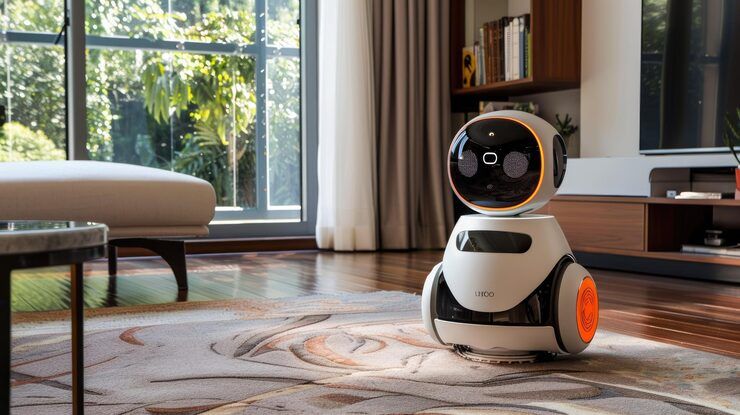
A robot vacuum cleaner, for example, can map rooms, identify obstacles, and clean designated areas automatically. A robotic lawn mower can follow programmed boundaries, while some home-monitoring robots can move through rooms and transmit video to an authorized user.
Smart home robots may use several technologies:
- Sensors: Detect obstacles, distances, movement, and environmental conditions.
- Artificial intelligence: Helps interpret sensor information and make certain decisions.
- Navigation systems: Allow robots to estimate their location and move through indoor or outdoor spaces.
- Wireless connectivity: Enables communication with mobile applications and connected devices.
- Actuators and motors: Control movement, brushes, wheels, arms, and other mechanical parts.
- Voice control: Allows compatible devices to respond to spoken instructions.
Not every smart home robot includes all these capabilities. Some follow simple programmed routes, while others use more advanced mapping and perception systems.
Importance: Why Smart Home Robots Matter
Household Convenience
Smart home robots can automate repetitive tasks such as floor cleaning, lawn maintenance, and certain forms of home monitoring. Scheduling functions allow compatible devices to operate at selected times without requiring someone to start every task manually.
Their usefulness depends on the household layout, the type of task, and the robot's ability to operate reliably in the environment.
Support for Independent Living
Robotic devices can help some older adults and people with mobility limitations by reducing the need to perform particular repetitive household tasks.
However, most household robots are not substitutes for human caregivers. A robot vacuum cannot provide personal care, and a home-monitoring robot cannot reliably replace emergency response systems or direct human assistance.
Energy and Resource Management
Some robotic devices can coordinate with connected thermostats, lighting systems, or environmental sensors. Robotic lawn mowers may also use scheduled operating patterns to maintain outdoor areas.
These capabilities do not automatically reduce energy consumption. Actual results depend on charging requirements, operating frequency, device efficiency, and how the robot is used.
Household Monitoring
Certain mobile robots contain cameras, microphones, or environmental sensors that allow remote observation of selected areas. They may help users check on pets or inspect a room while away.
Because these devices can collect sensitive information, households should carefully review camera access, cloud storage, microphone permissions, and security settings.
Types of Smart Home Robots
Different robots are designed for different household tasks.
| Robot Type | Main Function | Common Features |
|---|---|---|
| Robot vacuum | Cleans floors | Mapping, scheduled cleaning, obstacle detection |
| Robot vacuum-mop | Vacuums and performs selected mopping tasks | Water control, mop pads, room-based settings |
| Robotic lawn mower | Maintains lawns | Boundary detection, scheduling, charging station |
| Window-cleaning robot | Cleans suitable glass surfaces | Suction or attachment mechanisms, movement sensors |
| Pool-cleaning robot | Removes debris from pools | Brushes, filters, programmed cleaning cycles |
| Companion robot | Provides interaction and selected reminders | Voice interaction, sensors, entertainment functions |
| Mobile home-monitoring robot | Moves through selected indoor areas | Camera, remote control, navigation |
| Robotic pet toy | Provides automated play activities | Movement patterns, timers, interactive sensors |
The capabilities of individual devices differ. For example, a robot vacuum may handle open floors well but struggle with loose cables, high thresholds, thick rugs, or crowded rooms.
How Smart Home Robots Work
Sensors and Environmental Awareness
Sensors allow a robot to gather information about its surroundings. Infrared sensors, cameras, ultrasonic sensors, bump sensors, and laser-based distance sensors are used in different combinations.
A robot vacuum may use these sensors to detect furniture, estimate distances, identify stairs, or locate obstacles. Sensor performance can be affected by lighting, reflective surfaces, transparent objects, dust, and room layout.
Mapping and Navigation
Some robots create maps of rooms to plan efficient routes. Technologies such as simultaneous localization and mapping, commonly known as SLAM, help a robot estimate its position while building a representation of its surroundings.
Mapping may support room selection, no-go zones, and scheduled cleaning. However, maps can become inaccurate when furniture changes or the environment differs significantly from the conditions under which the robot was configured.
Artificial Intelligence and Machine Learning
AI can help robots recognize objects, classify obstacles, interpret commands, and adapt certain behaviors based on sensor data.
For example, a robot with suitable object-recognition capabilities may distinguish a shoe from an open floor area and change its route. Recognition is not perfect, so users should still remove small objects, cables, and potentially hazardous items before operation.
Connectivity and Smart Home Integration
Many robots connect to home Wi-Fi networks and mobile applications. Compatible devices may also integrate with smart speakers, home automation hubs, or other connected appliances.
Connectivity can support remote commands, software updates, cleaning schedules, and activity reports. Some functions may depend on an internet connection or a manufacturer's cloud platform, while others can operate locally.
Benefits and Limitations of Smart Home Robots
| Area | Potential Benefit | Limitation |
|---|---|---|
| Cleaning | Automates repetitive floor-cleaning tasks | May miss corners, stairs, or difficult surfaces |
| Scheduling | Runs selected tasks automatically | Requires configuration and occasional supervision |
| Navigation | Moves through mapped environments | Can struggle with clutter and unexpected obstacles |
| Home monitoring | Enables remote viewing in supported devices | Raises privacy and cybersecurity concerns |
| Maintenance | Can track operating conditions and notify users of certain problems | Brushes, filters, batteries, and sensors still need attention |
| Accessibility | Reduces some physical household tasks | Does not replace human care or assistance |
Smart home robots work most effectively when their capabilities match the task and the environment. Users should assess practical limitations rather than assuming that a device can operate without any supervision.
Recent Updates and Smart Home Robotics Trends
More Advanced Obstacle Recognition
During 2025 and 2026, home robotics development continued to focus on improved obstacle detection, navigation, and recognition of household objects. These capabilities can help robots handle cluttered spaces more effectively, although performance varies among devices and environments.
Before relying on a robot to navigate around pets, children, cables, or fragile objects, users should review its documented capabilities and test it under supervision.
AI-Based Interaction
Developments in AI have expanded interest in robots that interpret spoken instructions and respond more naturally to household requests. Some systems combine voice interaction with connected home controls.
However, conversational abilities do not necessarily mean that a robot can physically complete every requested task. A device may understand an instruction but lack the hardware, permissions, or navigation capabilities required to perform it.
Improved Home Automation Integration
Smart home platforms increasingly connect devices from different categories, including lighting, sensors, security systems, and household appliances. Compatible robots may participate in routines, such as beginning cleaning after residents leave a designated area.
Compatibility depends on supported communication standards, software versions, and device permissions. Buyers should verify interoperability before expecting two products to work together.
Battery and Maintenance Improvements
Battery management, docking, automated dust collection, and maintenance notifications remain important areas of product development. These features can reduce routine interaction, but batteries gradually degrade and consumable components still require replacement.
For current product-specific developments, consult manufacturers' technical documentation and recent product announcements.
Laws, Policies, and Privacy Considerations in India
Personal Data Protection
Smart robots equipped with cameras, microphones, or cloud-connected features may collect personal information. India's Digital Personal Data Protection Act, 2023, establishes a framework for digital personal data processing, subject to its provisions and applicable implementation rules.
The exact legal obligations depend on the circumstances and the relevant rules in force. Users should understand what information a device collects, where it is stored, and how it can be accessed or deleted.
Cybersecurity and Home Networks
Connected robots can become a security concern if accounts use weak passwords, software remains outdated, or remote access is not properly protected.
Useful precautions include:
- Use unique, strong passwords for device accounts.
- Enable multifactor authentication where supported.
- Install security and firmware updates.
- Review microphone, camera, and location permissions.
- Disable unnecessary remote access features.
- Use a separate guest or smart-device network when practical.
- Check whether the manufacturer provides a clear support period.
Electrical and Product Safety
Smart home robots should be used according to their electrical ratings, charging instructions, and safety warnings. Keep charging equipment away from water unless specifically designed for that environment.
Outdoor robots should be operated according to weather and environmental restrictions. Users should disconnect power as instructed before cleaning brushes, clearing jams, or performing maintenance.
Tools and Resources for Smart Home Robots
| Resource | Purpose |
|---|---|
| Manufacturer documentation | Explains installation, features, maintenance, and limitations |
| Smart home platform compatibility guides | Identify supported integrations and communication standards |
| Mobile device applications | Configure schedules, maps, settings, and notifications |
| Wi-Fi router security settings | Help manage connected devices and network access |
| Firmware update pages | Provide software updates and relevant security information |
| Privacy policies | Explain data collection, storage, and sharing practices |
| Product safety instructions | Describe charging, maintenance, and operating precautions |
Before choosing a device, compare its task capabilities, navigation method, maintenance requirements, privacy controls, software support, and compatibility with existing household systems.
FAQs About Smart Home Robots
What is a smart home robot?
A smart home robot is a device designed to perform one or more household tasks using automated controls, sensors, and sometimes AI. Examples include robot vacuums, robotic lawn mowers, window-cleaning robots, and mobile monitoring robots.
Do smart home robots need Wi-Fi?
Not always. Some robots can perform basic functions without an internet connection, while others require Wi-Fi for setup, remote control, cloud-based features, or software updates. Check the device documentation to understand which features work offline.
Can smart home robots work with voice assistants?
Some models support compatible voice assistants and smart home platforms. The available commands depend on the device, software version, regional availability, and platform integration.
Are smart home robots safe around children and pets?
Many devices include obstacle detection and other protective features, but they are not risk-free. Supervise initial operation, keep small objects and cables out of the robot's path, and follow the manufacturer's guidance for homes with children or pets.
Do smart home robots collect personal data?
Some connected robots collect information such as room maps, device usage, voice commands, or camera footage. The type of data depends on the model and its features. Review privacy settings and the manufacturer's data policy before enabling sensitive functions.
Conclusion
Smart home robots combine sensors, motors, navigation systems, software, and connectivity to automate selected household tasks. Robot vacuums, lawn mowers, pool cleaners, and mobile monitoring devices demonstrate how robotics can support everyday routines.
Their effectiveness depends on task suitability, environmental conditions, maintenance, and integration with other home systems. Privacy and cybersecurity also deserve attention, especially when cameras, microphones, and cloud-connected features are involved. By understanding these factors, households can make informed decisions about where robotics may be useful and where direct human involvement remains necessary.